
Independent industry research
Who Is Winning AI Visibility in the B2B Logistics Space?
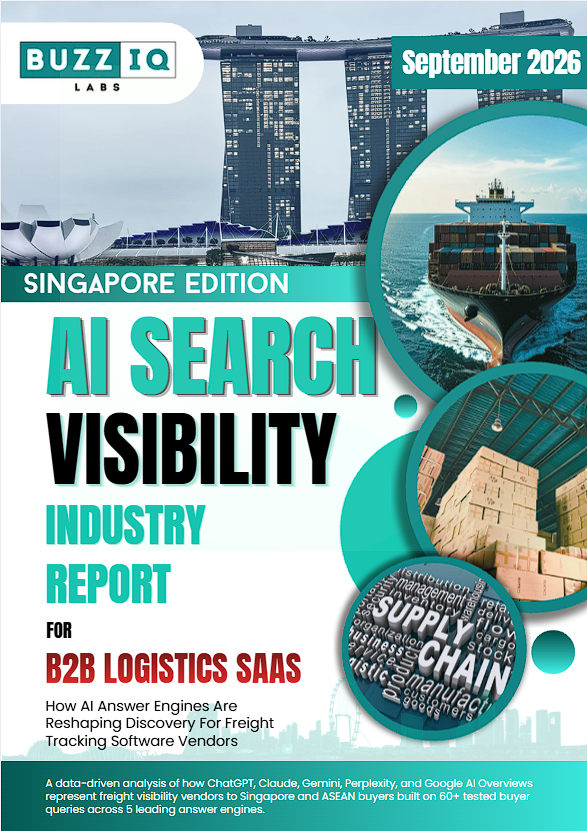
BuzzIQ Labs tested how five AI answer engines represent B2B logistics (freight-visibility) software vendors to Singapore and ASEAN buyers — revealing the silent shortlists shaping early consideration.
Tested across the surfaces shaping modern B2B discovery:
The dataset
A market study built to show what AI actually says.
Not a prediction. Not an opinion piece. A structured snapshot of how five answer engines surfaced, compared and described a defined cohort of B2B logistics software vendors to Singapore and ASEAN buyers. The 50-query commercial-intent core panel (250 evaluations) anchors the quantitative scoring; a further 10 category-expansion queries extend the keyword and whitespace analysis to 60 prompts in total.
Singapore-anchored plus global category-discovery intent.
ChatGPT, Claude, Gemini, Perplexity and Google AI Overviews.
The 50-query core commercial panel, scored across every engine under consistent controls.
Creating a comparable view of visibility, sentiment and share of voice.
Answer engines are already constructing silent shortlists for buyers before an RFP is ever issued.
Research design
Every answer leaves a trail.
A repeatable study design for understanding where a brand appears, how it is described, and which evidence AI trusts.
Define the buyer lens
60 prompts organised across SG commercial investigation, feature & integration, growth & evaluation, and vendor & category discovery intent.
Run the same questions
Each query was evaluated across ChatGPT, Claude, Gemini, Perplexity and Google AI Overviews for a clean comparison.
Score the evidence
Mention rate, share of voice, recommendation position, sentiment and review-volume confidence combine into a 0–100 visibility score.
What the study found
Visibility is concentrated. Behaviour is not.
The same vendor set produced five very different views of the market. That is the opportunity — and the risk — of AI discovery.
One cohort. Five different shortlists.
Engine preferences diverged sharply, and AI answers name just 3–4 vendors each (3.4 on average) — so placement is scarce. ChatGPT leaned on Portcast and other regional Asian SaaS with strong review profiles; Claude prioritised GoComet under strict entity verification; Gemini surfaced project44 and global enterprise platforms; Perplexity led with Shipsy from real-time web sources; and Google AI Overviews defaulted to Logi-Sys via localised schema. The gap is stark: a buyer on Gemini has roughly an 85% chance of seeing project44 for a given intent, but effectively 0% on Perplexity for the same question.
Top three vendors captured more than 36% of all recommendations.
Visibility was highly concentrated: the tracked top 10 account for 96.4% of all recommendations, leaving non-tracked platforms with under 4% of total visibility. A narrow recommendation set with real implications for category challengers.
Sentiment is starting to outrank feature depth.
GoComet posts the cohort’s strongest verified sentiment (93% positive) and ranks #2, while CargoWise — arguably the deepest platform tracked — posts the weakest (58%) on pricing and support friction. AI engines increasingly read review sentiment as a proxy for recommendation confidence.
Buyer intent
What buyers asked AI to solve.
The largest cluster was not broad “best of” discovery. It was specific, operational and integration-led.
Feature & integration specific
SAP/ERP fit, customs documentation, WMS connectivity, API access and container tracking were not edge cases. They were the largest share of the query set.
“Technical content directly fuels LLM citations.”
— Selected finding from the reportEvidence preview
The leaderboard is only the beginning.
A glimpse of the report’s composite view. Vendor names are intentionally obscured here — the full dataset is inside.
The implication
AI search is not one channel. It is an ecosystem of preferences.
Being discoverable in one answer engine does not guarantee presence in the next. Across all five surfaces, failing to optimise for Answer Engine Optimisation (AEO) can mean exclusion from 60%+ of early buyer consideration sets — before a sales team ever gets a call.
- Structured content and schema make expertise easier to verify.
- Third-party evidence and review depth strengthen trust signals.
- ASEAN-specific integration content creates a clear whitespace opportunity.
Download the research
See the full silent shortlist.
Get the complete AI Search Visibility Report for B2B Logistics SaaS — Singapore Edition, including the methodology, full query set, engine differences, visibility metrics and AEO recommendations.
Send me the full report.
Short form. Useful research. No noise.
Not ready for the full report?
Start with your own AI visibility baseline.
Request a free, focused visibility audit for your B2B SaaS or technology brand. See where you appear — and where the shortlist is forming without you.
Questions, answered
Before you download.
The full report includes the methodology, complete query themes, buyer-intent distribution, engine-by-engine behaviour, the 10-vendor visibility leaderboard, sentiment analysis and scorecard, pricing signals, content-gap and whitespace opportunities, and the recommended 90-day AEO strategy.
It is built for B2B SaaS, logistics technology, enterprise software, and growth teams that want to understand how AI answer engines shape early buyer consideration in Singapore and across ASEAN.
No. The report was independently researched and produced by BuzzIQ Labs. It was not sponsored, commissioned, or reviewed by any vendor named within, and no vendor was given advance access to the findings.
Yes. The free AI visibility audit is a separate, practical next step for teams that want to understand their own baseline across priority buyer queries and all five answer engines.
>