
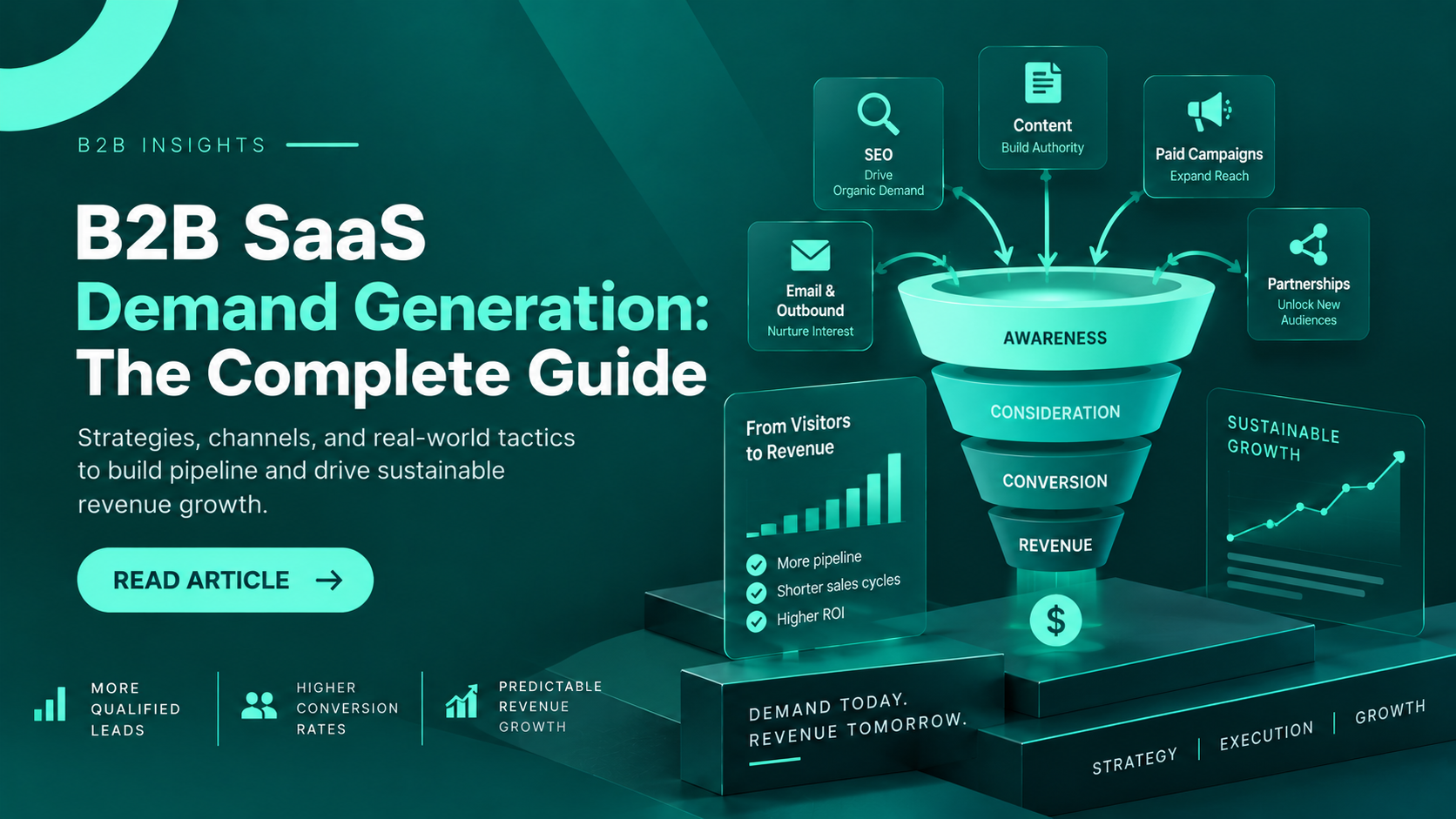
B2B SaaS Demand Generation: The Complete Guide
BuzzIQ Labs · 24 min read

Marketing teams build lead-scoring models, run nurture sequences, and report rising MQL counts quarter after quarter – while sales keeps asking why pipeline isn’t moving. The two functions are optimizing for different things, and nobody has said so out loud. This guide sets the record straight: what demand generation actually is, how it differs from lead generation, which channels and tools a modern B2B SaaS program needs, how to connect that activity to pipeline and revenue, and how senior marketing leaders should sequence the work. Every claim below is grounded in named, dated research rather than assumption, so you can act on it with confidence and defend the plan internally.
TL;DR
- Demand generation and lead generation are not the same discipline. Conflating them is the single most common reason marketing activity and pipeline drift apart.
- 6sense’s research on B2B buying behavior found that 70% of the buyer journey happens before a vendor has any visibility into the buyer, and 84% of deals are won by the first vendor a buyer contacts.
- A modern program coordinates five channel categories – paid, organic and AI-search visibility, account-based marketing, outbound, and lifecycle/product-led motion – supported by a defined technology stack.
- Gartner’s most recent CMO research found 56% of marketing leaders say their budget cannot support their strategy, which makes sequencing investment a strategic decision, not an operational afterthought.
- AI and automation are already reshaping demand generation execution, but Salesforce’s State of Marketing research found that data fragmentation, not AI capability, is the more common constraint on results.
Picture a Series B SaaS company hiring its first dedicated demand generation manager. Within a month, they stand up a lead-scoring model, a nurture sequence, and a dashboard tracking MQLs by source. Six months later, MQL volume is up 40% quarter over quarter. Sales is still asking why pipeline hasn’t moved.
Nobody did anything wrong, exactly. The team built a lead generation engine and called it demand generation. Those are not the same job, and the gap between them is where most B2B SaaS marketing budgets quietly underperform.
What Demand Generation Actually Means (and How It Differs from Lead Generation)
Demand generation is the set of marketing and sales activities that create awareness of a problem, build trust in a category of solution, and move a buyer toward a purchase decision. It spans the entire buying journey, not just the moment a prospect hands over an email address.
Lead generation is a subset of that. It’s the specific tactics – gated content, forms, paid lead campaigns – that capture contact information from people who are already, to some degree, in-market.
The practical difference shows up in what each discipline optimizes for. A lead-gen-only approach measures success in form fills and treats every contact the same way, whether they’re a year from buying or ready for a demo this week. A demand-gen approach measures success in pipeline and revenue, and treats different stages of the buying journey differently.
That journey is usually described in three stages. The labels vary by team, but the shape doesn’t:
Why B2B Buyers No Longer Follow the Traditional Funnel
The TOFU/MOFU/BOFU framework still holds. What’s changed is how much of it happens without the vendor ever knowing. 6sense’s research on B2B buying behavior found that roughly 70% of the buying journey happens before a buyer initiates contact with a seller at all. 6sense calls this phenomenon the “dark funnel.”
Two related findings make this more than an attribution footnote. The same research found that 84% of deals are won by the first vendor a buyer contacts, and that 78% of buyers have already mostly or completely settled their requirements before that first contact happens. A demand generation program that only starts working once a form is filled is, by these numbers, starting most deals already behind.
“B2B buyers are more comfortable using digital channels and GenAI to navigate the purchase process on their own, but that does not eliminate the role of the seller.”
— Robert Blaisdell, VP Analyst, Gartner Sales Practice
Gartner’s most recent B2B buyer survey backs this up with specifics. Buyers now consult an average of seven distinct information sources during a purchase – vendor sites, review platforms, analyst content, peer conversations, and AI tools – before a sales conversation adds much new information.
45% of buyers used generative AI during a recent purchase, mainly to research vendors and compare products. But 69% still want a sales rep to validate what the AI told them, and 51% say they’re concerned about encountering misleading information from GenAI specifically (49% say the same about sales reps). AI is additive to B2B buying right now, not a replacement for either content or sales conversations.
Underneath the buyer-behavior shift sits a resourcing problem most teams haven’t solved. Gartner’s CMO research found that 56% of marketing leaders say their current budget cannot support their strategy, even as CMOs now allocate an average of 15.3% of their marketing budget to AI tools and initiatives. Only 30% report having mature, scalable AI capabilities in place.
Building a Pipeline-Focused Demand Generation Strategy
A pipeline-focused strategy starts by rejecting the assumption that more top-of-funnel volume automatically produces more revenue. It doesn’t, and treating volume as the goal is how teams end up with the MQL-rich, pipeline-poor outcome described at the top of this guide.
Four principles separate pipeline-focused programs from activity-focused ones.
Start from the revenue target, not the channel mix. Work backward from the pipeline number the business needs, then determine which combination of channels, content, and account coverage can realistically produce it – rather than picking channels first and hoping the pipeline follows.
Segment by buying-stage readiness, not just firmographic fit. A target account that matches your ideal customer profile but isn’t yet aware of the problem needs different treatment than one actively evaluating vendors. Treating both the same way wastes effort on the accounts closest to a decision.
Build for accounts and committees, not just individual leads. B2B SaaS purchases routinely involve multiple stakeholders across departments. A strategy built around single-lead conversion misses the coordination that actually closes enterprise and mid-market deals.
Make the funnel work even when you can’t see the buyer moving through it. Given how much of the journey happens in the dark funnel, content and campaigns need to perform without relying on a tracked touchpoint at every stage. That means investing in discovery channels you don’t fully control – organic search, AI-generated answers, and peer communities – alongside the channels you do.
Build the business case before asking for budget. With over half of marketing leaders already saying their budget can’t support their strategy, a request for incremental investment needs to show projected pipeline impact, not just activity volume, to compete for scarce dollars. Framing new spend around the revenue-target principle above, rather than as a list of tactics, is what gets a budget request through a finance review intact.
The Core Channels of a Modern B2B SaaS Demand Generation Program
No single channel carries a demand generation program on its own. Buyers assembling their picture of a vendor from an average of seven sources means a program needs coordinated presence across several channel categories, not dominance in just one.
The mistake most teams make isn’t choosing the wrong channels – it’s running all five as separate budgets with separate owners and no shared measurement. Sopro’s same research found that 58% of B2B sales and marketing teams already use multiple outreach channels, but only 21% coordinate messaging across them. Coordination, not channel count, is where compounding results come from.
Want a revenue focused demand generation system?
See how our team builds coordinated demand generation programs across paid, organic, and ABM — tied to pipeline and revenue, not vanity metrics.
Demand Generation Tools B2B SaaS Teams Rely On
Channel strategy only works if the underlying technology stack can execute and measure it. Most mature B2B SaaS demand generation programs draw from seven categories of tooling. The right stack depends on company stage and go-to-market motion, but understanding what each category is actually for helps leaders evaluate whether their current stack matches their strategy.
CRM and marketing automation. The system of record for contacts, accounts, and campaign activity. Salesforce and HubSpot are the two most widely used platforms in B2B SaaS, with Adobe Marketo Engage common at larger, more complex organizations that need advanced lead scoring and multi-touch nurture logic. This layer is the foundation everything else reports into.
Intent data and account intelligence. Platforms like 6sense, Bombora, ZoomInfo, and Demandbase surface behavioral signals – content consumption, search activity, review-site research – that indicate an account is actively evaluating a purchase. The value of this category depends entirely on whether a team has built a workflow to act on the signal, not just receive it.
Advertising and campaign management. Google Ads and LinkedIn Campaign Manager remain the primary paid channels for B2B SaaS, since LinkedIn’s targeting by job title, company, and industry maps directly to how B2B buying committees are structured. Programmatic platforms extend reach for account-based display and retargeting campaigns.
SEO and content. Tools like Ahrefs and Semrush handle keyword research, backlink analysis, and technical SEO auditing. Content optimization platforms such as Clearscope and MarketMuse help teams structure content for both search rankings and topical authority – increasingly relevant as AI-generated answers pull from the same signals.
Analytics and attribution. Google Analytics 4 covers site-level behavior, while B2B-specific attribution platforms like Dreamdata and HockeyStack connect marketing touchpoints to closed revenue in a way generic web analytics can’t. This category is where most of the “connecting marketing to pipeline” work described later in this guide actually gets operationalized. Whichever platform a team chooses, consistency in how a touchpoint gets logged matters more than the specific vendor – attribution models break down fastest when tracking definitions change mid-quarter.
Sales enablement. Outreach and Salesloft manage sales sequencing and engagement, Gong and similar conversation intelligence platforms analyze sales calls for coaching and deal-risk signals, and Highspot or Seismic organize the content sales teams use during active deals. This is where demand generation output meets active selling.
AI and automation. A newer but fast-growing category. Tools like Clay combine data enrichment with workflow automation to personalize outbound at scale, Apollo.io combines prospecting data with sequencing, and general automation platforms such as Zapier or Workato connect the rest of the stack so signals move between systems without manual handoffs. These tools compress research and list-building work that used to consume a rep’s or marketer’s entire week, but a human still needs to verify accuracy before anything reaches a buyer.
No team needs every tool in every category on day one. The sequencing question – which categories to invest in first – is covered in the prioritization framework later in this guide.
Before adding anything new to the stack, weigh three questions: does a workflow already exist to act on what this tool surfaces, does it integrate cleanly with the CRM and marketing automation layer everything else reports into, and will a specific person or team own it after rollout. Tools purchased without clear answers to all three tend to become the disconnected point solutions this guide’s common-mistakes section warns against.
First-Party Data and Intent Signals: The Foundation Underneath Every Channel
As third-party tracking keeps eroding and more of the buying journey happens in the dark funnel, the data a company owns directly becomes its most reliable signal: CRM history, product usage, email engagement, and community activity. Every channel and tool described above draws from this foundation.
An ABM program with no clean account data, or a content strategy with no signal on what current customers actually search for, is building on guesswork. Intent data is the clearest example of a resource most teams already have but haven’t fully operationalized — Sopro’s research puts adoption at 87%, but consistent action on those signals at under half.
Closing that gap usually means building a routing workflow: a signal automatically triggering a sales alert, an audience update, or a personalized email sequence. That single workflow investment tends to unlock more value than adding a second or third intent data source on top of an unused first one.
Connecting Marketing Activity to Pipeline and Revenue
The gap between marketing activity and revenue outcomes is usually an attribution design problem, not a data availability problem. Most B2B SaaS companies already have the raw data. What’s missing is a model that connects it end to end.
Three practices make that connection work in practice.
Track marketing-sourced and marketing-influenced revenue separately. A single blended attribution number hides more than it reveals in a long, multi-touch B2B sales cycle. Marketing-sourced pipeline (deals marketing directly originated) and marketing-influenced pipeline (deals marketing touched but didn’t originate) answer different strategic questions, and leadership needs both.
Tie campaigns to a pipeline or revenue target from the start, not just a lead or MQL goal set after the fact. A campaign planned around “how much pipeline should this produce” gets evaluated and adjusted differently than one planned around “how many leads can this generate.”
Report on velocity, not just volume. How quickly does a marketing-sourced opportunity move through the pipeline compared to one sourced elsewhere? Slower velocity from a given channel or campaign is often a quality signal worth acting on before volume metrics would ever surface the problem.
None of this replaces sound sales and marketing alignment on lead definitions and handoff criteria. But without a deliberate attribution model, even perfect alignment on definitions won’t produce a clear picture of what’s actually driving revenue. For a deeper walkthrough of building this model end to end, see our CMO’s Guide to B2B Revenue Attribution.
Measuring Demand Generation Performance
Demand Gen Report’s ongoing benchmark research has tracked a broader industry shift away from MQL volume as the headline metric, toward sourced revenue, influenced pipeline, and customer expansion. That shift reflects the same MQL-versus-pipeline gap this guide opened with.
One benchmark worth planning around directly: NetLine’s research on B2B content consumption found that 45.9% of professionals who register for gated content expect to make a purchase decision within 12 months. Nearly half of every gated asset’s audience are active buyers on a defined timeline, not distant “someday” leads – and a generic, year-long nurture cadence wastes the window when they’re actually deciding.
A more complete measurement stack, beyond pipeline and revenue themselves, includes:
- Time-to-first-pipeline-touch — how quickly a signal converts into a sales or nurture action, since a slow handoff is where intent-data value most often gets lost.
- Account engagement depth — how many distinct buying-committee members at a target account are engaging, not just total account-level activity.
- Content-to-citation and organic visibility rate — whether priority content is ranking and being surfaced in AI-generated answers, tracked with the same discipline as keyword rankings.
- Marketing-sourced vs. marketing-influenced revenue — reported as two separate figures rather than one blended attribution number, especially in longer B2B sales cycles.
None of these replace pipeline and revenue as the top-line numbers leadership cares about. They’re diagnostic: each one points to a specific place in the funnel where value is most likely being lost.
Reporting cadence matters as much as the metrics themselves. A monthly readout that only shows lagging pipeline and revenue numbers gives leadership no chance to intervene before a channel underperforms for an entire quarter; a weekly or biweekly view of the diagnostic metrics above catches drift early enough to act on it.
How AI and Automation Are Changing Demand Generation Workflows
AI adoption in marketing is no longer a differentiator on its own – it’s close to table stakes. Salesforce’s State of Marketing research found that 75% of marketers have already adopted AI in some form.
Adoption alone hasn’t solved the underlying execution problem, though. The same research found that 84% of marketers acknowledge they’re still running generic, one-way campaigns despite that adoption, and that data fragmentation – not AI capability – is the more common constraint. Marketers with unified customer data were 42% more likely to respond to customers reliably and 60% more likely to successfully use AI agents at scale, according to the same study.
For demand generation specifically, AI and automation are showing the clearest impact in three areas:
Signal-to-action workflows. AI-assisted routing can act on intent and engagement signals in near real time, closing the activation gap described earlier in this guide — where most teams already collect intent data but few consistently act on it.
Personalization at scale. Tools that combine enrichment data with generation capabilities let outbound and ABM campaigns personalize messaging by account and buying-committee role, without a linear increase in manual production work.
Content and research acceleration. AI tools now assist with first-draft research synthesis, competitive analysis, and content structuring – compressing production timelines, provided a human still owns fact-checking, sourcing, and the final point of view.
The common failure mode is treating AI adoption as the finish line rather than the starting point. The data behind Salesforce’s findings is consistent: unified, accessible data is what determines whether AI investment actually improves outcomes, or just adds another disconnected tool to the stack.
How to Prioritize Channels, Content, Data, and Technology
With constrained budgets and multiple channel categories competing for investment, the programs that actually improve are the ones sequencing the work – not the ones trying to fix everything simultaneously. A simple three-tier way to think about it:
Tier 1 — Fix the leaks (weeks, not months)
Build the routing workflow that turns intent signals into sales or campaign actions within days. Segment gated-content registrants by buying timeline so the nearly half who plan to buy within 12 months get a faster path to a conversation instead of a generic drip sequence. Neither requires new headcount in most stacks – usually a CRM rule change and a tighter marketing-sales SLA.
Tier 2 — Rebuild the foundation (one to two quarters)
Consolidate first-party data across CRM, marketing automation, and product analytics into a single account view. Narrow ABM target lists to accounts with real fit and signal, and map the full buying committee for each one. This is the tier most teams try to skip, and the one that determines whether Tier 3 investment compounds or just adds disconnected activity.
Tier 3 — Compound the advantage (two quarters and beyond)
Invest in content and entity authority built for both search and AI-citation visibility, and build revenue attribution reporting that ties each channel to closed pipeline. Programs that reach this tier with a clean data foundation already in place are the ones where AI-assisted and ABM investment finally outperforms broad-reach programs.
Where Different Roles Should Focus First
| Role | Where To Focus First |
|---|---|
| CMO / VP Marketing | Build a revenue-attribution story before the next budget review. A credible marketing-sourced vs. marketing-influenced breakdown defends budget better than any single new channel. |
| Demand generation manager | Audit the intent-to-action workflow first – a signal sitting unused in a dashboard is a bigger leak than any new channel would fix. |
| Content / SEO lead | Treat top-of-funnel content as AI-citation surface area as much as ranking inventory – see our search visibility guide for specifics. |
| RevOps / marketing ops | Fix data fragmentation before adding another point tool – a clean, unified account view is what makes every channel and every AI investment actually measurable. |
| Sales leadership | Partner directly on account selection for ABM and on defining what marketing-sourced versus sales-sourced actually means before the next attribution debate starts. |
Common Mistakes That Undermine Demand Generation Programs
- Confusing lead volume with demand. A dashboard full of MQLs can hide a program that isn’t generating real pipeline – the most common failure mode described throughout this guide.
- Gating everything, all the time. Buyers increasingly expect a self-service research process. Gating comparison and evaluation content behind a form is a common way to lose exactly the buyers closest to a decision.
- Buying an intent data platform without building the routing workflow first. The tool gets purchased, the activation gap never closes, and the renewal conversation gets harder to justify.
- Running channels as separate budgets with separate owners. Without shared measurement and coordinated messaging, adding channels usually multiplies noise rather than pipeline.
- Treating AI adoption as a strategy rather than a capability. Buying AI tools without first fixing data fragmentation tends to reproduce existing execution problems faster, not solve them.
- Building activity without a funded, board-ready business case. A program that can’t show its pipeline impact in terms finance and leadership trust is usually the first budget cut when spending tightens, regardless of how well it’s actually performing.
What Marketing Leaders and Researchers Are Saying
The shift this guide describes – from lead volume to pipeline, from static funnels to buyer-controlled research, from broad AI adoption to disciplined execution – isn’t only visible in survey data. It shows up directly in how the people who study and run B2B marketing are framing the moment.
“CMOs recognize AI’s potential as a force multiplier for growth, efficiency and transformation, but most marketing organizations are not yet built to capture that value.”
— Ewan McIntyre, VP Analyst and Chief of Research, Gartner Marketing Practice
That gap between AI’s potential and organizational readiness echoes the data-fragmentation constraint discussed earlier in this guide. Adoption was never the hard part – building the infrastructure and workflows to act on what AI surfaces is.
“In the age of AI, what you don’t want to do is deploy and annoy all these agents.”
— Scott Brinker, VP of Platform Ecosystem, HubSpot, and editor of chiefmartec.com
Brinker, widely credited as the creator of the marketing technology landscape map and one of the field’s most closely followed voices on martech adoption, has repeatedly cautioned against deploying AI agents faster than a team can govern them responsibly – a warning that applies directly to the signal-to-action workflows this guide recommends building deliberately rather than bolting on.
“B2B leaders must embrace a more disciplined and evidence-driven approach to how they engage with generative AI, prioritizing trust and tangible value for buyers as they head into next year.”
— Sharyn Leaver, Chief Research Officer, Forrester
Leaver’s framing – trust and tangible value over novelty – lines up with the buyer-behavior research cited earlier in this guide: buyers are already skeptical of AI-generated content they can’t verify, and want a human to confirm it before acting on it. Marketing leaders who treat AI as a credibility tool rather than a volume tool are the ones most likely to benefit from it.
For a fourth perspective grounded specifically in buyer behavior, see the Gartner Sales Practice commentary quoted earlier in the section on why B2B buyers no longer follow the traditional funnel.
How BuzzIQ Labs Helps B2B SaaS Teams Build Pipeline-First Demand Gen
Most B2B SaaS marketing teams don’t need another disconnected vendor relationship. They need a partner who treats demand generation, search visibility, and revenue attribution as one connected system – because that’s how buyers actually experience a brand, whether or not internal teams are organized that way.
BuzzIQ Labs works with B2B Tech & SaaS marketing leaders as a strategic partner across the areas this guide covers directly:
Demand generation strategy. Benchmarked audits of where pipeline is currently being lost, followed by a documented roadmap sequenced the way this guide’s prioritization framework recommends – fix the leaks first, then rebuild the foundation, then compound the advantage.
SEO, AEO, and GEO. Content and technical work built for both traditional search rankings and citation inside AI-generated answers, since the two are converging rather than competing for the same content investment. Our answer engine optimization service and AI SEO service cover this work in detail.
AI-powered search visibility. Ongoing monitoring of how and where a brand is being surfaced across AI platforms, treated as seriously as keyword-rank tracking has always been treated.
Content and topic strategy. Editorial programs built around the buying-journey stages in this guide – TOFU problem-awareness content, MOFU comparison and evaluation assets, and BOFU decision-support material – rather than a generic content calendar disconnected from pipeline stage. See our content marketing service for how we structure this work.
Lead generation and marketing automation. Campaign execution and nurture-sequence design that assumes buyers are self-directed, not funnel stages waiting to be pushed.
Conversion optimization. Improving the paths from content and campaigns to a conversation, trial, or purchase – closing exactly the kind of friction this guide flags as a common mistake.
Data-driven pipeline growth and AI-enabled workflows. Helping teams consolidate first-party data, build the intent-to-action routing workflows this guide describes as high-leverage, and apply AI and automation to execution without treating tool adoption as a substitute for a clean data foundation.
A typical engagement starts with a diagnostic audit against a company’s current funnel, technology stack, and attribution model, followed by a phased roadmap. Paid programs usually show early signal within four to six weeks; organic and account-based programs generally need a full quarter or more to build momentum, with compounding results appearing as content authority and account coverage build over time. Reporting is built around pipeline and revenue impact from the start, on a regular cadence, so marketing leaders can see what’s working and adjust before a full quarter is lost to an underperforming channel. Every engagement is scoped around a specific, board-defensible pipeline outcome, not a generic list of marketing deliverables.
Frequently Asked Questions
What is the difference between demand generation and lead generation?
Lead generation captures contact information from buyers who are already in-market. Demand generation is the broader discipline of creating and capturing demand across the entire buying journey, measured by pipeline and revenue rather than form fills alone.
What channels should a B2B SaaS demand generation program include?
A modern program typically coordinates five categories: paid media, organic content and AI-search visibility, account-based marketing, outbound and intent-driven prospecting, and lifecycle or product-led motion – run together rather than as separate budgets.
What is the “dark funnel,” and why does it matter?
It’s 6sense’s term for the roughly 70% of the B2B buying journey that happens with no tracked touchpoint. It matters because a funnel that only starts working at form-fill is, by that measure, starting most deals already behind.
Should marketing teams still track MQLs?
MQL volume is still a useful operational signal, but it shouldn’t be the primary measure of success. Treat it diagnostically, alongside pipeline and revenue metrics, rather than as the headline number in a leadership report.
How long does it take to see results from a new demand generation program?
It depends on the channel. Paid programs typically show early signal within four to six weeks. Organic content, AI-search visibility, and account-based programs generally take a full quarter or more to build momentum, with results compounding from there.
What’s the biggest barrier to a better demand generation program?
Data fragmentation, more consistently than budget or headcount. Incomplete or scattered data undermines attribution, intent-signal activation, and AI tool performance alike – which is why this guide treats data consolidation as a foundational, not optional, step.
How is AI changing demand generation execution?
AI is accelerating signal-to-action workflows, personalization at scale, and content research – but adoption alone hasn’t solved execution problems. Unified, accessible data is what determines whether AI investment improves outcomes or just adds another disconnected tool.
Is account-based marketing part of demand generation or a separate discipline?
ABM is one of the core channels inside a demand generation program, not a separate discipline. The two increasingly share the same data foundation, account targeting, and measurement approach.
What’s a realistic first KPI to move when starting a pipeline-focused program?
Time-to-first-pipeline-touch is usually the fastest to change, since fixing it depends on a workflow adjustment rather than new budget or headcount. Improving it also tends to surface where intent and engagement signals are currently going unused.
Do smaller B2B SaaS marketing teams need all five channel categories?
No – sequencing matters more than coverage. A small team typically gets more from doing two or three channels well, with a clean data foundation underneath them, than spreading thin across all five from day one.
How should a team decide what to build in-house versus buy as a tool?
Build only what’s genuinely differentiating to the business; buy for anything that’s already a solved problem elsewhere, such as CRM, intent data, or campaign management. Most B2B SaaS marketing teams get better return compounding on strategy and content than on internal tooling.
How does account engagement depth differ from simple lead volume?
Lead volume counts individual contacts; account engagement depth tracks how many distinct buying-committee members at one target account are actually engaging. An account showing depth across several roles is a stronger buying signal than several accounts each showing a single, shallow touch.